





Lesson Summary
This activity offers an engaging way for students to conduct research on a specific aquatic invasive species (AIS) based on a research source being “caught” during a fishing game. Sources of research include websites, Sea Grant factsheets, pamphlets, journal articles and other library resources.
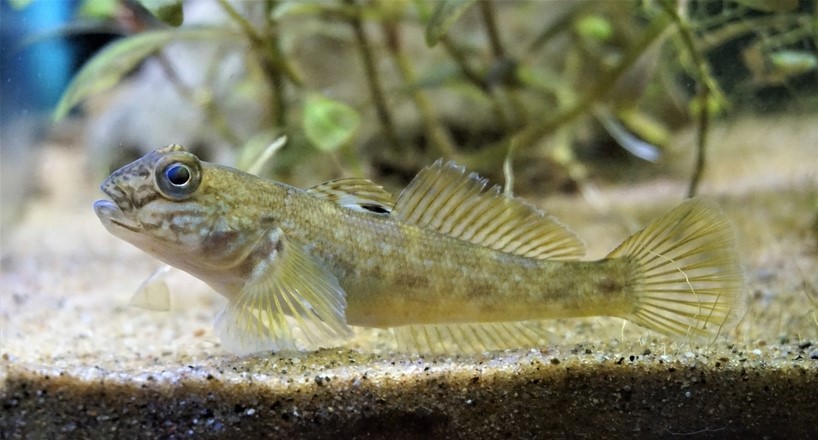
Photo Credit: David Jude

Objectives
Students will be able to:
- Identify and explain the characteristics of one AIS, including physical description, habitat, mode of introduction, ecological impact and potential solutions.
- Interact in cooperative learning groups to share research information about an AIS with other students, create a poster and give an oral presentation to classmates.

Lesson Alignment
Next Generation Science Standards: MS-LS2-2, MS-LS2-4, MS-LS2-5, MS- ESS3-3
Materials
The factsheet and clue cards are provided with this lesson.
- Invasive Species Factsheet
- Invader Clue Cards
- 3” x 5” index cards (1 per student)
- Magnets (attached to back of each clue card or to use on the poles)
- Four fishing poles (or wooden dowels)
- Paper clips or doughnut-shaped magnets (one attached to each line of the pole)
- Poster paper (one sheet for each group of four)
- Markers and/or colored pencils
- Articles, factsheets or pamphlets
Time Required
This lesson will require three-four class periods to complete.
Vocabulary
- Ballast water
- Biodiversity
- Common name
- Competition
- Ecosystem
- Invasive species
- Habitat
- Indigenous species
- Mode of introduction
- Native species
- Nonindigenous species
- Nuisance species
- Scientific name
Background
The introduction of aquatic invasive species (AIS) into the Great Lakes ecosystem threatens plant and animal biodiversity. Often AIS have adaptations or behaviors that may offer them a competitive advantage over other species. This can sometimes negatively impact populations of native species, either directly such as predation or competition for habitat resources or indirectly such as altering the environment or food webs. Awareness and education about AIS may be the best way to prevent the spread of these invaders.
Helpful Hints
- Prepare clue cards in advance (teacher can fill in sources or have students find their own).
- Collaborate with the school librarian to locate additional resources.
- Bookmark websites prior to activity.
- Arrange and set up tables in advance.
- Use labels to indicate which article/pamphlet/factsheet should be at each location.
- Encourage students to reach beyond the required questions.
- Display posters on bulletin board or in hallway to share with all students in the school.
Lesson Procedure
Preparation
- Prepare clue cards for the fishing expedition so that each source is represented on an index card. Use the clue card master as well as your own sources: article, pamphlet, website, or other resource.
- Attach magnets to the bottom of each card with the blank side facing up. Attach paper clips to the fishing pole (or attach paper clips to the edge of each card and magnets to the poles).
- Spread out materials onto different tables and label them to avoid confusion.
Individual Research (50 minutes)
- Introduce the topic of AIS and provide a working definition for the term. Locate relevant places on a map: the five Great Lakes, St. Lawrence River, Lake Champlain, Atlantic Ocean, Black Sea, and Caspian Sea.
- Distribute the blank factsheet to each student. Briefly explain that they will obtain the following information: common name, scientific name, physical characteristics, native habitat or location, current habitat or location, mode of introduction, ecological impacts, potential solutions and a drawing or picture.
- Have each student use a fishing pole with a paper clip or magnet hook to “fish” for a research clue on an AIS. The card provides a source for the student to investigate first and assigns an AIS to the student.
- Students continue to investigate resource(s) of his or her choices and complete the information on the factsheet.
Sharing Information in Groups (50-100 minutes)
- Students investigating the same species come together at the same table to form a cooperative learning group. They share information from various resources and discuss ideas. This can include having students list possible solutions for the problem and ways to increase the public’s awareness. If a written test is desired, you could also have the groups synthesize questions for use on a written test.
- Students design and create an educational poster that includes a picture and information about the AIS. Encourage students to present information in an original, imaginative, and unique manner.
Group Presentations (50 minutes)
- Student groups present information to classmates using their poster as a visual aid. Classmates may ask questions about their AIS (about 5-10 minutes per group).
- Show prepared slides about AIS (optional). Provide additional information and answer student questions. Summarize by discussing questions such as:
- Why do the Great Lakes have such a problem with AIS?
- What procedures now exist that may prevent further introduction of AIS into the Great Lakes?
Wrap-Up
- Possible assignment rubric (100 points):
- 30 points: Poster (creativity, originality, neatness)
- 30 points: Presentation (eye contact, clarity, poise, information)
- 20 points: Factsheet
- 20 points: Student evaluation (15 points = evaluation by 3 other groups members; 5 points = self-evaluation)
- A written test based on the questions generated in step 8 could be used for formal evaluation.
Extension
- Additional assignments, extra-credit work, or interdisciplinary activities:
- Find 10 additional facts on each AIS.
- Create a Webpage for each AIS.
- Create and label a map that shows where an AIS originated and where it has spread.
- Explain the effect of the unintentional consequences of ballast water discharges on the spread of AIS in the Great Lakes.
- Find out why the sport-fishing industry is so important to the Great Lakes region and what the economic impact of this industry is in the basin or the Great Lake nearest your school.
- For a creative language arts activity, write a short story about an aquatic invasive species’ journey to the Great Lakes.
- Invite a scientist, biologist or researcher to your school to share the latest information on AIS.
Additional Resources
Websites:
- EPA, Invasive Species in the Great Lakes
- U.S. Geological Survey, Biological Resources Division, Nonindigenous Aquatic Species
- Great Lakes Aquatic Nonindigenous Species Information System
US Geological Survey Factsheets:
- Round goby
- Rusty Crayfish
- Dreissenid mussel
- Eurasian Ruffe
- Sea Lamprey
- Purple loosestrife
- Spiny water flea
Articles:
- Invasive Crayfish Collaborative, Invasive Crayfish 101
- Great Lakes Now, Mussel Invasion Legacy Reaches Far Beyond Great Lakes
Credits
- Created by: Jim Alvaro, Anchor Bay School District, Clinton Township, MI
- Modified by: Terri Hallesy, Illinois-Indiana Sea Grant
- Invader Picture cards, Introduction cards, and Ecosystem Impact cards were included in the student activity of this lesson with permission from Ohio Sea Grant.

This lesson is part of a larger curriculum, Ripple Effects.


