





Lesson Summary
Students will act as reporters to research the effects of sea lamprey on the ecosystem. They write investigative reports, prepare posters, and/or give presentations to the class.
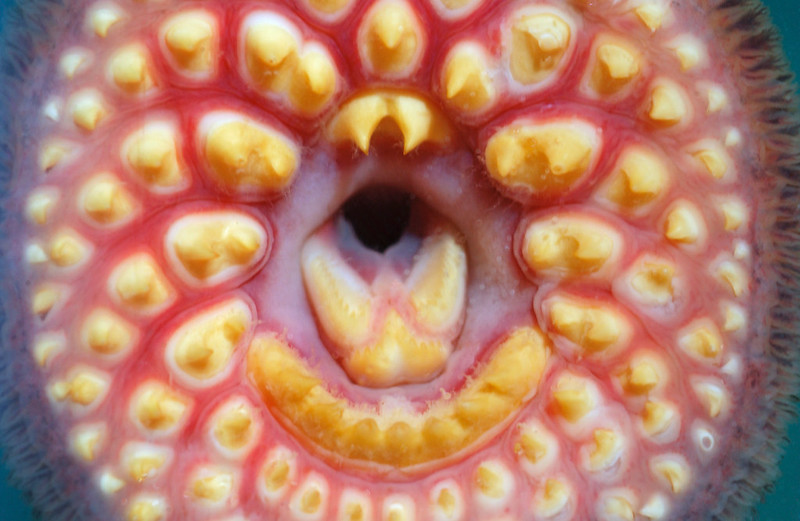
Photo Credit: Michigan Sea Grant

Objectives
Students will be able to:
- Use research skills and analyze scientific information about sea lamprey.
- Identify the impacts made by aquatic invasive species (AIS) and explain that these impacts do not occur from malicious intent, but rather through natural exploitation of resources.
- Create a poster and presentation.

Lesson Alignment
Next Generation Science Standards: MS-LS2-2, MS-LS2-4, MS-LS2-5, MS- ESS3-3
Materials
- Poster board
- Glue or paste
- Computer with internet access for PowerPoint presentations
Time Required
This lesson will require three-five class periods to complete.
Vocabulary
- Invasive species
- Habitat utilization
- Homeostasis
- Predator-prey relationship
- Resources
- Sea lamprey
Background
The sea lamprey (Petromyzon marinus) is a fish that is invasive in the Great Lakes system. They are characterized by their suction cup mouths with rows of sharp teeth and rasping tongue. They are jawless and their bodies lack bony structures.
Sea lampreys are native to the Atlantic Ocean and are found along the Eastern coast of North America. Sea Lamprey were primarily introduced unintentionally to the Great Lakes by swimming through man-made shipping canals. The Erie Canal (in the U.S.) and Welland Canal (in Canada) were constructed in the early 1800s to help ships bypass natural barriers like Niagara Falls, however these man-made canal systems then also opened a pathway for Sea Lamprey to invade the Upper Great Lakes.
They were first discovered in Lake Ontario in 1835. Niagara Falls previously served as a natural barrier to the other Great Lakes, containing invasive sea lampreys to Lake Ontario, but improvements to the Welland Canal connected Lake Ontario to Lake Erie, and allowed them to circumvent the waterfall. The population exploded once it was established aided by their reproductive ability (one female Sea Lamprey can produce up to 100,000 eggs) paired with availability of spawning habitat (gravel substrate) and larval habitat (sedimentary substrate) found in the many freshwater streams across the Great Lakes watershed.
After several years filtering organic matter in rivers and streams, Sea Lamprey juveniles then begin a transformation into parasitic adult. These newly-formed adults then migrate to the Great Lakes where they feed on host fish for 12–18 months. Once in the Great Lakes, adult Sea Lamprey found access to an abundance of host fish like Lake Trout and Whitefish to feed upon. While Sea lampreys are parasites on larger fishes found in their native Atlantic Ocean parasites, they instead became a devastating invasive predator when introduced to the Great Lakes due to a lack of natural predators and prey that hadn’t evolved defenses against them.
Sea lampreys have had a profound effect on the native fish populations, such as lake trout and whitefish. A single sea lamprey can kill about 40 pounds of fish during its parasitic life cycle in the Great Lakes. They use their sucker-like mouth to attach to fish, rasp through their scales and skin with their teeth, and feed on their blood and body fluids eventually killing a large proportion of their host fish. As a result. This has earned them the nickname the “Vampires of the Great Lakes.” This parasitic predation has historically reduced and even collapsed fish populations, negatively impacting recreational, sport charter, and commercial fishing industries in the Great Lakes.
Today, Sea Lamprey are actively managed in the Great Lakes thanks to a sustained, binational program coordinated through the Great Lakes Fishery Commission. The sea lamprey control program uses lampricides to kill larval sea lampreys in tributaries of the Great Lakes. These lampricides are pesticides that are selective to sea lampreys. Physical barriers and traps are also utilized as a control tactic to prevent upstream migration and spawning. Future of sea lamprey control innovations even includes the study of pheromones which involves using specific chemical cues—both attractants and repellents—to manipulate sea lamprey behavior for management purposes. Their population has been suppressed by about 90% since the mid-20th century, preventing the collapse of the ecosystem and the region’s fishery valued at more than $4 billion dollars annually.
Source: Great Lakes Fishery Commission. (2024). Sea lamprey. https://www.glfc.org/sea-lamprey.php
Helpful Hints
This activity should follow an introductory lesson on AIS. It would be helpful to have taught investigative reporting skills utilizing the five W’s (Who, What, Where, When, Why?) and research skills.
Lesson Procedure
- Provide a brief introduction to AIS and show pictures and actual specimens (if available). Please note: preserved sea lamprey are available from science supply companies and it may be possible to borrow them from local college biology departments, US Fish & Wildlife Service offices, state environmental conservation departments or Sea Grant offices, where permitted.
- Explain that students will be researching the sea lamprey to present information in the form of a poster or PowerPoint presentation, in conjunction with a written investigative news report. Explain that they will be creating an “Interview with a Vampire” due to the sea lamprey’s need to suck the blood and body fluids out of fishes.
- Assign the following questions to direct the students’ research (sample responses are provided) and have them include the information into their final poster, PowerPoint presentation or report:
- Where does the sea lamprey naturally occur? They are native to the coastal Atlantic Ocean.
- How did the sea lamprey enter the Great Lakes and inland waterways? They migrated through the St. Lawrence River and Welland and Erie Canals.
- When did the sea lamprey arrive? It is believed that they entered Lake Ontario before scientists began studying the environment and were first reported in the 1830s. They were found in Lake Erie in the 1920s and recorded in all the Great Lakes by 1938.
- What is their reproductive strategy? They enter freshwater to spawn by building crescent- shaped nests, where they lay as many as 60,000 eggs. Of these, less than 1,000 survive long enough to hatch, which takes place in 10-20 days.
- What are other important life history factors? Migration? Life cycles? Normally, sea lamprey live in the ocean, but migrate into freshwater to spawn, although they can live their entire life in freshwater, as they do in the Great Lakes basin. The sea lamprey larvae burrow into mud or soft sediment where they can spend 3-17 years, depending on environmental conditions. The larval sea lamprey feed on plankton, detritus and small organisms, until they reach “transformer” size (about the size of a pencil). In the Great Lakes, the transformers begin their journey out to the open water and spend approximately 12-20 months as parasitic adults.
- Do they have any natural predators in inland waters? In the Great Lakes, adult sea lamprey have very few predators, although bald eagles have been known to prey upon them.
- How do they disrupt the ecosystem? There has been a noticeable decline in native fishes such as lake trout and whitefish, which has resulted in a disruption of the predator-prey balance. Sea lamprey feed on all the large species of fish in the Great Lakes including Chinook and coho salmon, brown and rainbow trout, walleye, burbot and even sturgeon.
- Can sea lamprey be removed or controlled? The Great Lakes Fishery Commission is responsible for controlling sea lamprey and they routinely treat spawning streams and creeks with a chemical lampricide, which is a pesticide that is selective to lampreys. Other control methods include various barriers: Low-head dams, adjustable-crest barriers, as well as velocity and electrical barriers. Anglers can help by checking their minnow traps to make sure they are not moving larval sea lamprey from Great Lakes tributaries.
- Assign due dates for outlines of the poster or PowerPoints and their reports. Schedule 5-10 minute presentation times, including a question and answer period and discussion.
- Make sure the class knows about the available resources, including the Internet, school library, environmental agencies and the Great Lakes Fishery Commission.
- After the two days of research, provide guidelines for the poster or PowerPoint slides. The key to the poster or slides is to make them concise. Encourage students to use a minimum amount of text and make type size large enough to be easily read. You may wish to suggest a poster or PowerPoint slide format like the following:

Wrap-Up
- Evaluation is based on the written responses to questions assigned in number 3 in the Lesson Procedure above.
Additional Resources
Websites, Factsheets, and Publications:
- Great Lakes Fish Commission About Sea Lamprey
- Great Lakes Fishery Commission Sea Lamprey Control
- Great Lakes Fish Commission Lampricide video
- Great Lakes Aquatic Nonindigenous Species Information System
- Sea Lamprey: GLANSIS video
- U.S. Geological Survey, Biological Resources Division, Nonindigenous Aquatic Species Site
- NOAA: What is a sea lamprey?
Credits
- Originally created for ESCAPE Compendium, Great Lakes Sea Grant Network
- Created by: Peter L. Edwards, Jay Cooke State Park, Carlton, MN
- Modified by: Terri Hallesy, Illinois-Indiana Sea Grant

This lesson is part of a larger curriculum, Ripple Effects.


