





Lesson Summary
Through a simulation, sampling, and estimation activity, students learn about the impact of purple loosestrife on a wetland due to its exponential growth. They learn about the life cycle of purple loosestrife and appreciate how scientists determine population size in an ecosystem.
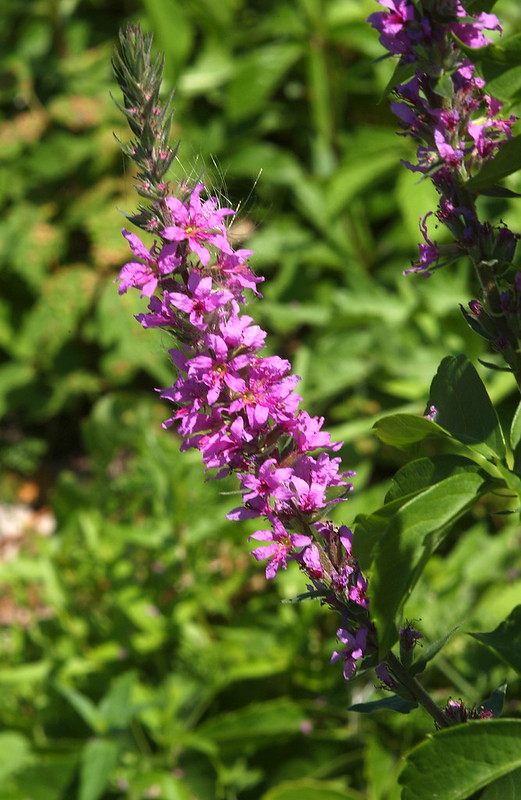
Photo Credit: Michigan Sea Grant

Objectives
Students will be able to:
- Recognize purple loosestrife and tell how the seeds are dispersed.
- Describe that purple loosestrife produces over 2 million seeds and have a concept of how much that really is.
- Determine the population of purple loosestrife seeds for their wetland ecosystem through sampling.

Lesson Alignment
Next Generation Science Standards: MS-LS2-2, MS-LS2-4, MS-LS2-5, MS- ESS3-3
Materials
The factsheet and worksheets are provided in the lesson.
- Purple loosestrife (Lythrum salicaria) factsheet
- Dot worksheet
- How Much is Two Million Seeds? worksheet
- One bag of purple paper confetti (or hole-punches from purple construction paper)
- Fan or blow dryer
- Meter sticks
- String (optional)
Time Required
This lesson will require three class periods to complete.
Vocabulary
- Population
- Purple loosestrife
- Sampling
Background
Purple loosestrife is an aggressive nonindigenous plant that rapidly disperses throughout wetland areas. It interferes with the growth of native species and fills in the spaces where the natives would normally grow. Purple loosestrife creates many problems through its competitive advantage that cause an imbalance in the wetland ecosystem.
Helpful Hints
Students should already have an introduction to invasive species and their impact on ecosystems and native populations.
Students should know how to multiply and use a calculator. It would be helpful for students to be able to use linear measurements to construct a grid.
Lesson Procedure
- Distribute the informational factsheet on purple loosestrife. Have the students read it independently or read it aloud as a class.
- Distribute the Dot Worksheet and have students complete the worksheet How Much Is Two Million Seeds? to realize the enormity of this number. If possible, bring in two reams of paper (500 sheets). Two reams of paper with 50 dots on each page would make 2 million dots!
- Groups of students should be given large sheets of paper or poster board and asked to draw a wetland ecosystem. The teacher can show pictures of wetlands to help them understand.
- Students make a grid on their wetland by drawing lines to make equal-sized sections. For example, poster board that is 22 x 28 inches (56 x 70 centimeters) could be divided into sections of 14 square centimeters. Students could mark off every 14 centimeters down (4 marks) and every 14 centimeters across (5 marks). The total number of sections would be 20. Then have students draw lines in at these marks. Finally, have students number the poster board sections.
- Each group lines up their wetland ecosystem side-by-side leaving no spaces. The teacher spreads out a bag of purple confetti (or purple hole-punches) on cardboard. With a fan or hair dryer, the teacher simulates the wind and spreads the “seeds” to every ecosystem.
- Students should take their ecosystem back to their desks. Have students estimate how many purple loosestrife seeds are in one section. Then they should estimate how many seeds are dispersed throughout the whole ecosystem. Students should look at their wetland and choose what section should be used to count the purple loosestrife seeds. All the seeds in this section are to be counted. To find the estimate, students should know that the size of the population equals the number in the section that was counted multiplied by the number of sections: population estimate = number in one section x number of sections.
- If there is time, have students estimate and then count another section. Compare the results.
- Compile the data from each of the groups. The ecosystem closer to the parent plant (fan) will receive more seeds (confetti or hole-punches). Notice how the seeds can be spread by the wind.
- Discuss the following questions (with sample answers):
- Purple loosestrife seeds can also travel by water and on things that move from place to place. It can also reproduce from its roots and parts of the stem. How would this affect our findings?
- The different ways they are transported would affect how far and fast the seeds could be dispersed.
- Did each section of your wetland ecosystem have the same number of seeds? Which wetland ecosystems had the most seeds? The least seeds? What factors determined which wetland ecosystem got the most?
- Each section counted should yield a different number of seeds. Students need to realize that typically a scientist cannot possibly count every organism in the environment.
- Purple loosestrife seeds can also travel by water and on things that move from place to place. It can also reproduce from its roots and parts of the stem. How would this affect our findings?
Wrap-Up
- Have students describe how to count the number of insects in a square meter area of the playground, using the sampling method.
- By making calculations, have students compute how many sheets of paper with dots are needed to make 3 million.
Extension
- Have students describe how to count the number of insects in a square meter area of the playground, using the sampling method.
- By making calculations, have students compute how many sheets of paper with dots are needed to make 3 million.
Additional Resources
Factsheets and Publications:
- Why Are Wetlands Important?, USEPA
- Purple Loosestrife, Minnesota Department of Natural Resources
- Purple Loosestrife, Wisconsin Sea Grant
Website:
Kits:
Credits
- Originally created for ESCAPE Compendium, Great Lakes Sea Grant Network
- Created by: Peter L. Edwards, Jay Cooke State Park, Carlton, MN
- Modified by: Terri Hallesy, Illinois-Indiana Sea Grant

This lesson is part of a larger curriculum, Ripple Effects.


